


By Jordan Macnab · Macnabs Real Estate Team · Tri-Cities & Ridge Meadows
A lot of homeowners across Port Moody, Coquitlam, Port Coquitlam, Pitt Meadows, and Maple Ridge are sitting on more opportunity than they realize. Thanks to a significant shift in BC provincial law, many standard residential lots that used to be single-family only can now accommodate a laneway home — no rezoning application required. But “can” and “will” are different things, and the answer depends on a few key factors specific to your property.
This post breaks down exactly what makes a lot laneway-ready in our corridor, what the new provincial rules actually changed, and what you’ll want to check before spending a dollar on drawings.
What changed — and why it matters for you
In November 2023, the BC government passed Bill 44 — the Housing Statutes (Residential Development) Amendment Act. It came into full effect June 30, 2024. The short version: municipalities across BC can no longer zone exclusively for single-family homes. That means if you own a standard residential lot in Port Moody, Coquitlam, PoCo, Pitt Meadows, or Maple Ridge, provincial law now gives you the right to add a secondary suite, a laneway home, or both — as of right, without going through a lengthy rezoning process.
Before Bill 44, adding a laneway home alongside a secondary suite could mean an 18-to-36-month rezoning process. That barrier is largely gone now.
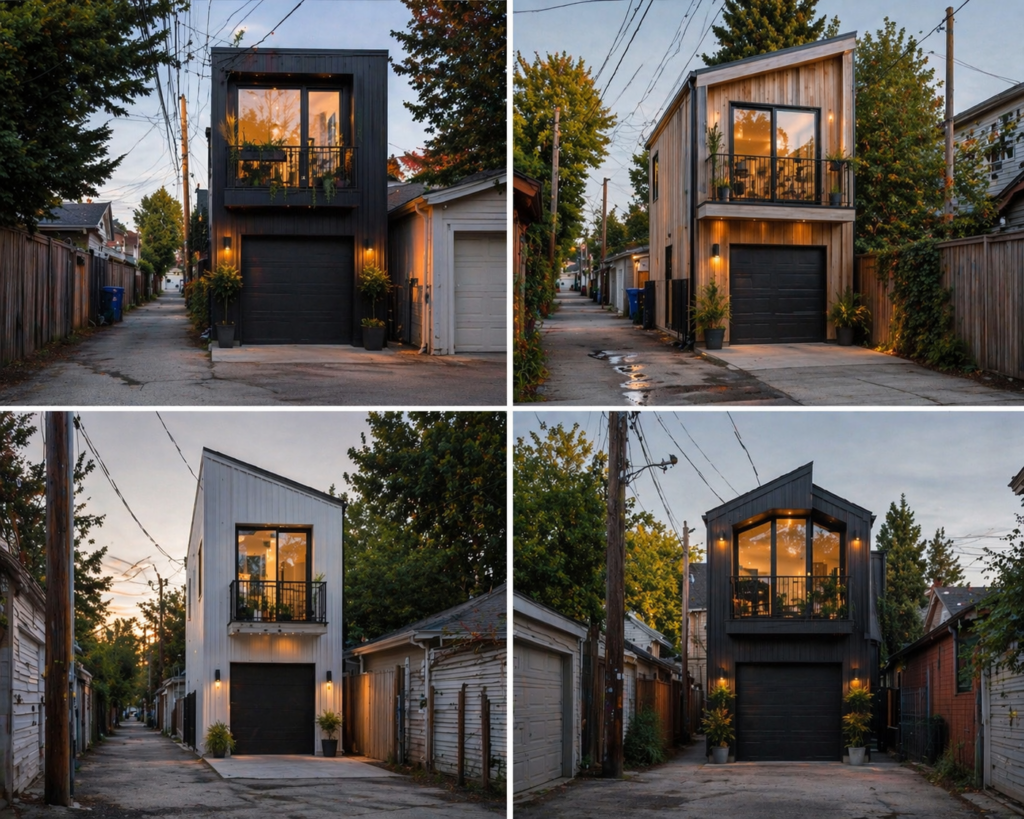
The basic lot requirements
Not every lot automatically qualifies for a full laneway home — size, access, and servicing still matter. Here’s what the provincial framework sets out, and what local municipalities layer on top.
Lot size and unit count
Here’s how Bill 44 breaks it down by lot size:
- Lots under 280 m² (about 3,014 sq ft) — at least 3 dwelling units permitted
- Lots between 280 m² and 4,050 m² — at least 4 dwelling units permitted
- Lots over 280 m² near a frequent transit stop (service every 15 min or better) — up to 6 units permitted
- Lots over 4,050 m² (about 1 acre) are generally exempt from these requirements
A “dwelling unit” can be your main home, a secondary suite inside the house, or a detached laneway home out back. So on a typical 6,000 sq ft lot in Coquitlam or Maple Ridge, you’re looking at 4 units permitted — meaning your existing home plus a secondary suite plus a detached laneway home is entirely on the table.
Lane access
This is the one that trips people up most often. A laneway home — by definition — needs lane access at the rear of the property. If your lot backs onto a lane, you’re in a strong position. If it doesn’t, you’re likely looking at a garden suite or carriage house configuration instead, which has its own rules around setbacks and access from the side or front.
In Port Moody and parts of Coquitlam, rear lanes are common in older neighbourhoods. In newer subdivisions in Maple Ridge and Pitt Meadows, they’re less prevalent — so check your property survey before assuming.
Setbacks and lot coverage
Each municipality sets its own setback rules — how far a structure must sit from the rear property line, side fences, and other buildings. Typically a laneway home needs to be within about 1 metre of the rear property line (facing the lane) and maintain side setbacks of around 1.2 metres. Height limits usually sit between 5.5 and 7 metres for a one- or two-storey laneway home.
Lot coverage — the percentage of your lot that can be covered by all structures combined — is the other cap to watch. Most residential zones in our corridor set this around 40–45%, and a laneway home counts toward that total.
What about servicing?
This is where construction expertise really counts. A laneway home needs its own independent services — its own electrical panel fed from the street, its own water line, its own sewer connection, and its own heat source. Depending on how far your service connections run and the condition of your existing infrastructure, this can add meaningfully to your project cost.
In established parts of Port Moody and Coquitlam, the service connections are usually straightforward. In some areas of Maple Ridge and Pitt Meadows, you may be farther from mains — and the municipality may require upgrades. This is one of the first things I look at when assessing a lot, because it can make or break the budget.
Is your neighbourhood in the Bill 44 zone?
Bill 44 applies to all BC municipalities with more than 5,000 residents — every community in our corridor qualifies. Coquitlam requested an extension in 2024 due to some specific infrastructure constraints, but the bylaw updates are underway. Port Moody, Port Coquitlam, Pitt Meadows, and Maple Ridge are all working through their compliance updates.
The practical takeaway: even if your municipality’s updated zoning bylaw isn’t fully published yet, the provincial law is already in effect. You have the right to apply for a building permit for a laneway home on a qualifying lot.
Your quick lot assessment checklist
Before you call a builder, run through these:
- Does your property back onto a lane? (Required for a true laneway home)
- What is your lot size in square metres? (Determines how many units are permitted)
- Is your lot within an urban containment boundary? (Required for Bill 44 to apply)
- Are there any easements, rights-of-way, or covenants on title that might restrict building?
- What is your current lot coverage — how much of the lot is already built on?
- Where are your existing water, sewer, and electrical connections located?
- Are there any heritage designations or strata restrictions on your property?
If you can answer all of those confidently, you’re well ahead of most homeowners starting this process. If a few are question marks, that’s exactly what a preliminary lot assessment covers — and it’s a conversation worth having before you invest in drawings.
What does “laneway-ready” actually feel like?
The lots I see move fastest through the permit process share a few things in common: a clear rear lane, a lot size comfortably over 5,000 sq ft, straightforward service connections, and a clean title with no restrictive covenants. When those four things are in place, the path from decision to permit approval is genuinely much shorter than most people expect — often four to six months from start to permit issuance, depending on the municipality.
The trickier projects are the ones where lot coverage is already tight, where the lane is shared or private, or where the sewer line is on the far side of the property. That doesn’t mean it’s a dead end — it just means the planning needs to happen before the excitement.
Whether you’re thinking about building a laneway home to house family, generate rental income, or increase your property value ahead of a sale, the starting point is always the same: know your lot.
Not sure if your lot qualifies? Let’s find out.
I offer a no-obligation lot assessment for homeowners across the Port Moody to Maple Ridge corridor. We’ll look at your lot size, lane access, servicing, and local bylaws — and give you a straight answer.
📞 Call or text Jordan Macnab — Macnabs Real Estate Team
604-551-5695
jordan@themacnabs.com
www.themacnabs.com
About Jordan Macnab: Jordan grew up in a construction family — his dad was a builder and project manager — and has been learning how homes go together since before he could drive. He worked for major BC builders including Polygon and Progressive, earned his Construction Safety Officer certification, and won HGTV’s Canada’s Handyman Superstar Challenge. That led him to found VARIX Construction, a Tri-Cities renovation company he ran for over 10 years. In 2008 he added his Real Estate license, bringing the build and the buy together under one roof with the Macnabs Real Estate Team.