

By Jordan Macnab · Macnabs Real Estate Team · Tri-Cities
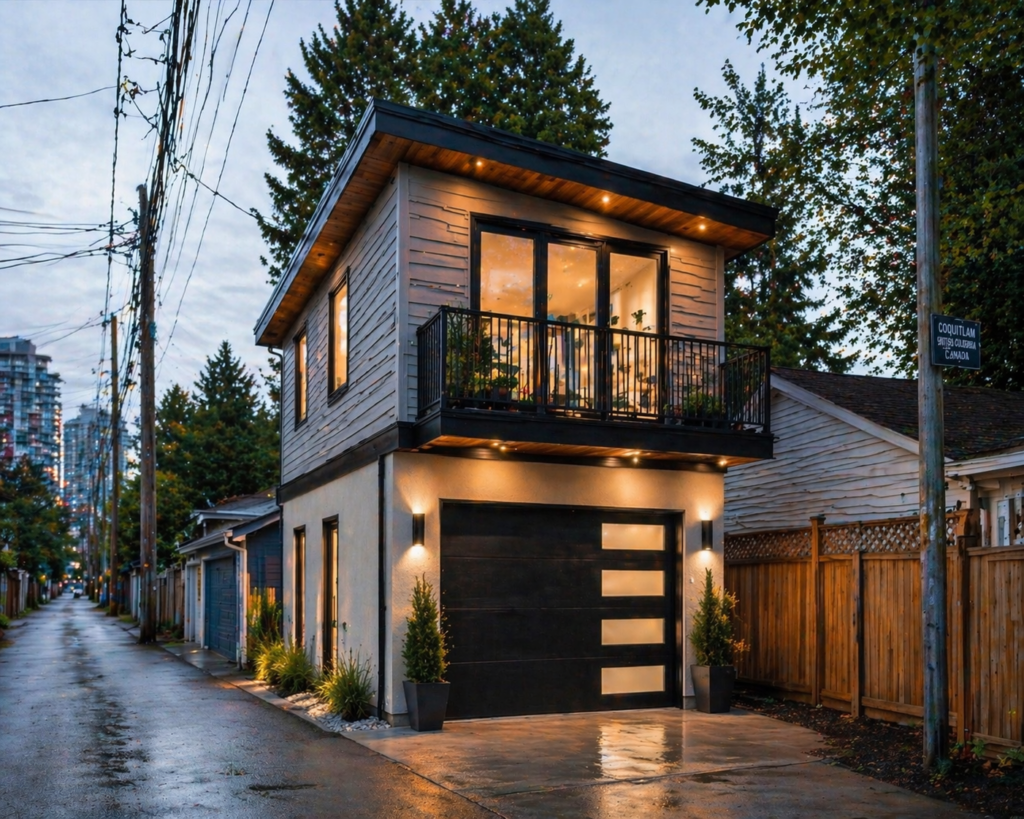
Port Coquitlam homeowners have been sitting on a quiet opportunity for the past couple of years, and most don’t fully realize it yet. Under BC’s new provincial housing legislation, most standard residential lots in PoCo that used to be single-family only can now accommodate a laneway home, a garden suite, a secondary suite, or a combination of all three — without going through a rezoning application.
PoCo actually moved faster than most Tri-Cities municipalities to get its bylaws updated. The City has already amended its zoning to comply with the province’s Small-Scale Multi-Unit Housing (SSMUH) rules, which means the path from decision to building permit is more straightforward here than in some neighbouring cities. Here’s what you need to know.
What did Port Coquitlam actually change?
In response to BC’s Bill 44, Port Coquitlam amended its Zoning Bylaw to permit up to 4 dwelling units on most properties currently zoned RS1 through RS4 — the standard single-family residential zones that cover the majority of PoCo neighbourhoods. The types of development now permitted in these zones include:
- A single residential home or duplex
- A secondary suite inside the main home
- An accessory dwelling unit (ADU) — which is what most people mean when they say laneway home, coach house, or garden suite
- Combinations of the above, up to the 4-unit maximum
One thing Port Coquitlam did differently from some other municipalities: the City required a Small-Scale Multi-Unit Housing Development Permit before a building permit can be issued for any new duplex, development with 3 or more units, or any accessory dwelling unit. This is an extra step compared to a straight building permit, but it’s still far simpler than a full rezoning process.

How many units can you build on your PoCo lot?
As with the rest of the province, the number of units you can build comes down to lot size:
- Lots 280 m² (3,014 sq ft) or smaller — up to 3 units permitted
- Lots larger than 280 m² and under 4,050 m² (1 acre) — up to 4 units permitted
- Lots 4,050 m² (1 acre) or larger — up to 1 principal unit plus 1 accessory unit
Most PoCo lots fall in that middle bracket, meaning 4 units are on the table. In practical terms, that’s your main home, a suite inside it, and a laneway home or garden suite out back — all permitted on a standard residential lot.
One important exception to know: SSMUH rules don’t apply to RS-zoned properties within a designated Transit-Oriented Area (TOA). PoCo has two Skytrain-adjacent TOAs (around Coquitlam Central and Lincoln Station) and a West Coast Express/bus exchange TOA around Port Coquitlam Station. If your property is near one of these stations, check your specific zoning before assuming SSMUH rules apply — those areas have their own separate density framework.
The Development Permit step — what it means for you
This is the part most PoCo homeowners don’t know about until they’re partway through the process. Unlike some municipalities where an accessory dwelling unit goes straight to a building permit, Port Coquitlam requires a SSMUH Development Permit first for any new ADU or multi-unit development.
Small-scale residential properties are designated as Development Permit Areas in PoCo’s Official Community Plan, meaning the City reviews your project for how it fits the neighbourhood in terms of form, character, and landscaping before issuing the permit. This isn’t as onerous as it sounds — it’s not a rezoning — but it does add a step and some lead time to your project timeline. Factor this in when you’re planning your schedule.
What are the real costs beyond construction?
This is where a lot of PoCo homeowners get caught off guard, and it’s worth being direct about. Beyond what it costs to actually build the laneway home, the City requires all SSMUH developments to cover offsite costs — work outside your property boundary to connect new housing to existing infrastructure. These can include:
- Road and lane upgrades — widening, paving, signage to meet servicing bylaw requirements
- Water, storm, and sanitary connections — connecting to municipal systems and upgrading existing mains
- Underground utility connections for electricity and telecommunications
- Sidewalk and pathway construction or upgrades
- Corner lot dedications — if you’re on a corner, the City may require you to dedicate a triangle of land at the intersection, plus potential access changes
- Development Cost Charges (DCCs) — collected on all new units to fund roads, parks, water, sewer, and drainage infrastructure city-wide
Here’s the number that gets people’s attention: for corner lots with lane access on two sides, the City has seen offsite costs exceed $100,000. That’s not typical for a standard interior lot, but it’s a real number and it underscores why a proper site assessment is so important before you get excited about floor plans.
Costs vary significantly depending on your property location and the condition of existing infrastructure on your street and lane. This is one of the first things I dig into when assessing a lot, because it can completely change whether a project makes financial sense.
What zone is your PoCo property in?
Port Coquitlam has four single-family residential zones — RS1, RS2, RS3, and RS4 — each with slightly different regulations around density, lot size, and what’s permitted. The SSMUH bylaw amendments apply across all four zones, allowing up to 4 units on qualifying lots. If you’re not sure which zone your property is in, the City’s PoCoMAP tool at portcoquitlam.ca lets you look up your address and see your current zoning and Official Community Plan designation in seconds.
What about the Fraser and Manning area?
PoCo requested and received a provincial extension specifically for the Lougheed/Shaughnessy corridor — the area between Fraser Avenue and Manning Avenue, sandwiched between Lougheed Highway and Shaughnessy Street. The City has been acquiring properties in this area and needed more time to work through the planning before SSMUH rules fully applied. If your property is in this corridor, the rules may differ — check directly with the City.
My take as someone who has built throughout PoCo for years
Port Coquitlam is one of the better municipalities in the Tri-Cities for actually getting a laneway home or garden suite built. The City moved quickly to comply with the province, the process is reasonably well-defined, and the older neighbourhoods east of the Coquitlam River have a good number of lots with rear lane access — which is the #1 thing you need for a true laneway home.
The Development Permit requirement is a step that trips people up, but it’s manageable if you know it’s coming. The offsite costs are the bigger wildcard, and they’re genuinely difficult to estimate without looking at your specific property, your frontage, and the infrastructure on your street. I’ve walked a lot of PoCo lots and the difference between a straightforward project and a complicated one often comes down to what’s happening at the lane and property line — not the building itself.
If you’re thinking about adding a laneway home or suite in Port Coquitlam — whether for rental income, multigenerational living, or to add value before a sale — start with a realistic assessment of your lot before you spend anything on design.
Want to know what’s possible on your PoCo lot? Let’s talk.
I offer a free, no-obligation lot assessment for Port Coquitlam homeowners. With decades of hands-on construction experience across the Tri-Cities and a real estate background, I can give you a straight read on what’s buildable, what it’ll likely cost, and whether it makes sense for your situation.
Contact JORDAN MACNAB
604-551-5695 – Jordan@themacnabs.com

About Jordan Macnab: Jordan grew up in a construction family — his dad was a builder and project manager — and has been learning how homes go together since before he could drive. He worked for major BC builders including Polygon and Progressive, earned his Construction Safety Officer certification, and won HGTV’s Canada’s Handyman Superstar Challenge. That led him to found VARIX Construction, a Tri-Cities renovation company he ran for over 10 years. In 2008 he added his Real Estate license, bringing the build and the buy together under one roof with the Macnabs Real Estate Team.
Sources: City of Port Coquitlam SSMUH webpage (portcoquitlam.ca), City of Port Coquitlam New Provincial Housing Legislation page, BC Housing Statutes (Residential Development) Amendment Act (Bill 44), 2023. Always verify current bylaws and zoning with the City of Port Coquitlam before making development decisions.